Posts

Showing posts with the label javascript

shelljs node module

Let me share a little gem I've found: shelljs node module . I was working on updating my Cordova hooks to work with Windows environment and had to replace my bash script with the corresponding JS code. Unfortunately, the node modules I've found were disappointing, especially copying the files. Surely I could write the copying code by myself, but I supposed that in 2016 year one is not required to do such menial tasks. The biggest problem for the modules I've tried was the glob matching - I have to copy files from the sibling directory, and modules couldn't find it (looks like they don't parse ".." notation). I've tried fs.extra, fs-extra, ncp, filecopy, cp, but no luck. I guess I could find the good module after all, but after I've discovered shelljs I don't need it anymore anyway. With shelljs porting the code was a piece of cake - see the results below (the original and the new scripts).
split function behavior differences

A little note from my debugging experience. Split function works differently and I would say unexpectedly for empty string in different programming languages, and it can cause difficult to find bugs (especially if you use a lot of languages simultaneously). I've created a table with the popular programming languages: Language Split without parameters Split with parameter Python ''.split()=[] ''.split(',')=[''] Ruby ''.split()=[] ''.split(',')=[] JavaScript ''.split()=[''] ''.split(',')=[''] PHP N/A explode(',', '')=array(0=>'') Java N/A "".split(",")={""} C# "".Split()={""} "".Split(',')={""} As you can see sometimes it returns empty array, but sometimes an array with the one empty element. So please be careful with the split operation :)

Python vs JS vs PHP for embedded systems

UPDATE (07/18/17): The original article was written in 2011 and pretty much outdated, I've updated the numbers and conclusions. I've got a question about which programming language is preferable for the website development for embedded systems (with limited resources). Here is my small investigation in a table form. Please note that the question was about only these 3 programming languages - there are better candidates for the embedded systems now (for example, Rust). The Memory and Performance overhead numbers are based on the n-body benchmark and calculated as relatives to "C gcc #4" measurements. Python 3 Node.js PHP Memory Overhead x7.62 x29.04 x8.53 Type System Strong Typing Weak Typing Weak Typing Vulnerabilities 220 1411 5626 Performance Overhead x78.31 x2.82 x30.12 Documentation Excellent Excellent Average C Bindings Excellent Average Poor Code Readability With PEP8 it can be almost perfect ESLint enforces very good style PEAR Coding Stan...

CouchDB introduction

Image
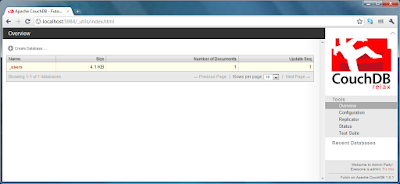
A phenomenon of document-oriented databases is quite interesting - many software developers face problems there this kind of databases is an excellent choice, but these developers don't use them and reinvent the wheel using relational or object-oriented databases. Difficult to say why it happens - because of ignorance, fear of performance problems or desire to reinvent own wheel, but this situation widely spread over the world. Fortunately, the common sense is prevailing, and NoSQL movement prove it. I have a serious experience with IBM Lotus Notes/Domino , and one of the most interesting features for me on first stages of its studying was saving application design in the documents. Thus the deployment of Lotus Notes database is incredibly easy - one just have to copy NSF-file to another location and it's ready for use (not always, but for trivial cases it's enough). Sometimes it can be a really useful feature, especially during prototyping, but not so many document-orie...

Explaination of JavaScript "The Da Vinci Code"

Novice security researchers can reach an impasse analyzing the such-like JS-code (it generates an alert): (É=[Å=[],µ=!Å+Å][µ[È=-~-~++Å]+({}+Å) [Ç=!!Å+µ,ª=Ç[Å]+Ç[+!Å],Å]+ª])() [µ[Å]+µ[Å+Å]+Ç[È]+ª](Å)  I would like to remove the veil of secrecy, and explain how it works. It uses several JS-rules: implicit type conversion; arrays indexing; string and arithmetic operations (unary and binary); JSON-based object creation; referencing the global object ( window ) using some functions with invalid or empty parameters; accessing properties by bracket notation. Let me show it in action via JavaScript Shell : [] //explicit empty array declaration ![] //implicit conversion to the Boolean value false []+![] //implicit conversion to the String value false ([]+![])[3] //get a char by index 3 s a=[],++a //implicit conversion to the Integer value 1 ([]+![])[a=[],++a] //use several implicit conversion, get a char by index 1 a {} //explicit empty object creatio...