Posts

Python vs JS vs PHP for embedded systems

UPDATE (07/18/17): The original article was written in 2011 and pretty much outdated, I've updated the numbers and conclusions. I've got a question about which programming language is preferable for the website development for embedded systems (with limited resources). Here is my small investigation in a table form. Please note that the question was about only these 3 programming languages - there are better candidates for the embedded systems now (for example, Rust). The Memory and Performance overhead numbers are based on the n-body benchmark and calculated as relatives to "C gcc #4" measurements. Python 3 Node.js PHP Memory Overhead x7.62 x29.04 x8.53 Type System Strong Typing Weak Typing Weak Typing Vulnerabilities 220 1411 5626 Performance Overhead x78.31 x2.82 x30.12 Documentation Excellent Excellent Average C Bindings Excellent Average Poor Code Readability With PEP8 it can be almost perfect ESLint enforces very good style PEAR Coding Stan...

DIY: Business cards in LaTeX

Image
Business card can be handy in many cases, and it's not a big deal to create it at home. Let me show one of the methods. Prerequisites We need to have: matte presentation paper (weight 44 lb/165 g/m 2 in my case); razor paper trimmer (I've used X-ACTO 12" Personal Paper Trimmer , but can't recommend it - it has a habit to stuck in the middle of the trimming process); printer (don't know about laser printers, but ink one works fine for me); LaTeX software. The last point can be challenging, because LaTeX is not so smooth and user friendly as it can be. My basic recommendations: install Perl (it's required by auto-pst-pdf package); update/install all the required LaTeX packages (e.g., some Linux distributions provide incredible old LaTeX packages); use "-shell-escape" command line option for pdflatex command; if nothing helps, don't use "auto-pst-pdf", but build DVI/PS file, and convert it to PDF. Single business ca...

Mini HOWTO: Getting file names in Zip-archives using Bash

Image
I'm gathering stats about my archives, and one of these is getting all the file names in them. There are some challenges about it, so let me show the required commands. Getting file names from the one archive: unzip -l /path/to/zip-file | tail -n +4 | head -n -2 | cut -c31- Executing pipelined commands in xargs: xargs -I {} -i sh -c 'command1 | command2 | ... | commandN' For my case I've used the expression: find . -iname "*.zip" -print0 | xargs -0 -n1 -I {} -i sh -c 'unzip -l {} | tail -n +4 | head -n -2 | cut -c31-' | sort | uniq -c Yeah, yeah, black magic, gotcha Good luck!

CouchDB introduction

Image
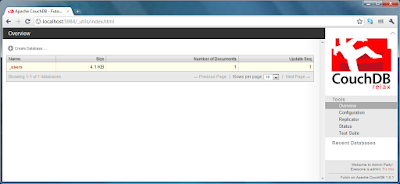
A phenomenon of document-oriented databases is quite interesting - many software developers face problems there this kind of databases is an excellent choice, but these developers don't use them and reinvent the wheel using relational or object-oriented databases. Difficult to say why it happens - because of ignorance, fear of performance problems or desire to reinvent own wheel, but this situation widely spread over the world. Fortunately, the common sense is prevailing, and NoSQL movement prove it. I have a serious experience with IBM Lotus Notes/Domino , and one of the most interesting features for me on first stages of its studying was saving application design in the documents. Thus the deployment of Lotus Notes database is incredibly easy - one just have to copy NSF-file to another location and it's ready for use (not always, but for trivial cases it's enough). Sometimes it can be a really useful feature, especially during prototyping, but not so many document-orie...

C modules unit-testing in Linux

Image
In spite of its age, C programming language is still very popular, especially for developing system or low-level software like drivers, compilers, virtual machines etc. And as any software, it have to be tested. Let me show brief introduction in unit-testing for C modules. There are many unit-testing frameworks for C, and one of the most well-known is cmockery . But I'll show the usage of much more simpler "framework" - FCTX . The main advantage of it is that it consists of just one header file, so it can be easily used for test tasks, small projects and examples. For calculating code coverage I use gcov / lcov tools. Gcov is included in GCC, so you don't have to install it. Lcov is a graphical front-end for Gcov and should be installed from the repository: $ sudo apt-get install lcov As a sample code for testing I'll use a simple hash function from Robert Sedgwicks Algorithms in C book: #include "hash.h" unsigned int RSHash(char* str, uns...

Is Python appropriate language for the developing high-load systems?

The short answer - yes . The reasons are below: There are well-knows systems (like YouTube) that shows Python suitability: YouTube Architecture The most performance problems are related with not a language speed, but with communication and databases speed. Let me show the example from my own experience: I've worked on project that process a huge amount of data (about inserting 100-200k records a day, and selecting from about 100-200 million records 10-20 times per second). The bottleneck was a database, not the language speed. All indexes were pretty complex, and selecting can take up to 30-90 seconds which was inappropriate. We had to change architecture: use data pool, caches, AMQP (with RabbitMQ server), and after that we don't know any problems at all with performance. Right tools means everything. For example, if you have to serve enormous web-requests, just use the suitable webserver like Tornado . Especially it is useful for serving Comet -based web applications. A...

Explaination of JavaScript "The Da Vinci Code"

Novice security researchers can reach an impasse analyzing the such-like JS-code (it generates an alert): (É=[Å=[],µ=!Å+Å][µ[È=-~-~++Å]+({}+Å) [Ç=!!Å+µ,ª=Ç[Å]+Ç[+!Å],Å]+ª])() [µ[Å]+µ[Å+Å]+Ç[È]+ª](Å)  I would like to remove the veil of secrecy, and explain how it works. It uses several JS-rules: implicit type conversion; arrays indexing; string and arithmetic operations (unary and binary); JSON-based object creation; referencing the global object ( window ) using some functions with invalid or empty parameters; accessing properties by bracket notation. Let me show it in action via JavaScript Shell : [] //explicit empty array declaration ![] //implicit conversion to the Boolean value false []+![] //implicit conversion to the String value false ([]+![])[3] //get a char by index 3 s a=[],++a //implicit conversion to the Integer value 1 ([]+![])[a=[],++a] //use several implicit conversion, get a char by index 1 a {} //explicit empty object creatio...